
Canada’s Largest Youth
Transit Resource Library
Our goal is to create an aggregated, open-access library of resources to help communities who are exploring free youth transit programs for youth. Do you have something to add to this page? Please let us know!
The Kingston Model
Kingston Youth Transit Resources
In 2012, Program Director Dan Hendry helped plant the seeds for the Get On the Bus youth transit movement in Kingston, Ontario. In partnership with the Limestone District School Board and the City of Kingston (Kingston Transit), he introduced the transformative Kingston High School Bus Pass Program. This simple yet powerful model gave high school students free bus passes, along with hands-on training that built confidence in navigating public transit.
The results were remarkable: Kingston high school students increased their transit use from 28,000 to nearly 600,000 rides annually (pre-Covid numbers). This dramatic leap demonstrates the impact of our core philosophy: when you equip youth with the tools, skills and encouragement they need to use public transportation, they gain real-world independence and a sense of agency – and become dedicated transit riders.
This “Kingston Model” championed by Get On The Bus is about more than free rides; it’s about creating a lasting cultural shift. By cutting carbon emissions, building life skills and empowering youth, we’re proving that a simple bus pass can be a catalyst for widespread change in how communities move and grow.

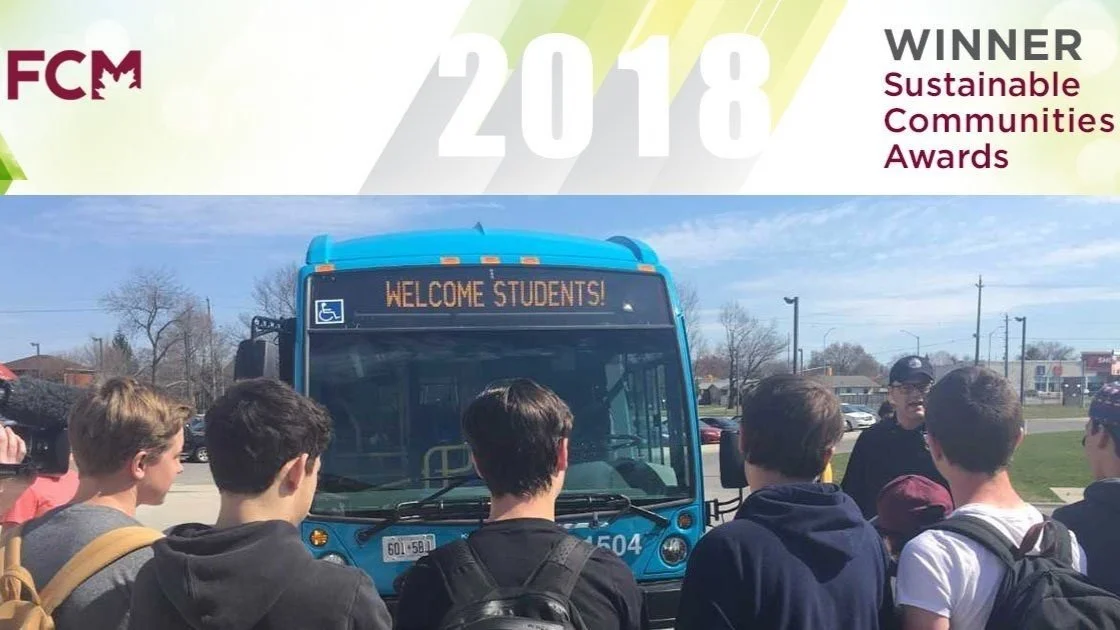
Federation of Canadian Municipalities

City of Kingston — Council Reports
High School Transit Pass Program: An Investment Case
New Study Confirms the Educational, Environmental, and Economic Value of Kingston’s High School Transit Pass Program
Credit: Ontario Association of School Business Officials (OASBO)
A 2025 evaluation commissioned by the Ontario Association of School Business Officials (OASBO) provides the most detailed analysis to date of Kingston’s High School Transit Pass Program. The investment case report, conducted by Limestone Analytics, confirms Kingston’s program as one of Canada’s most effective youth-mobility models.
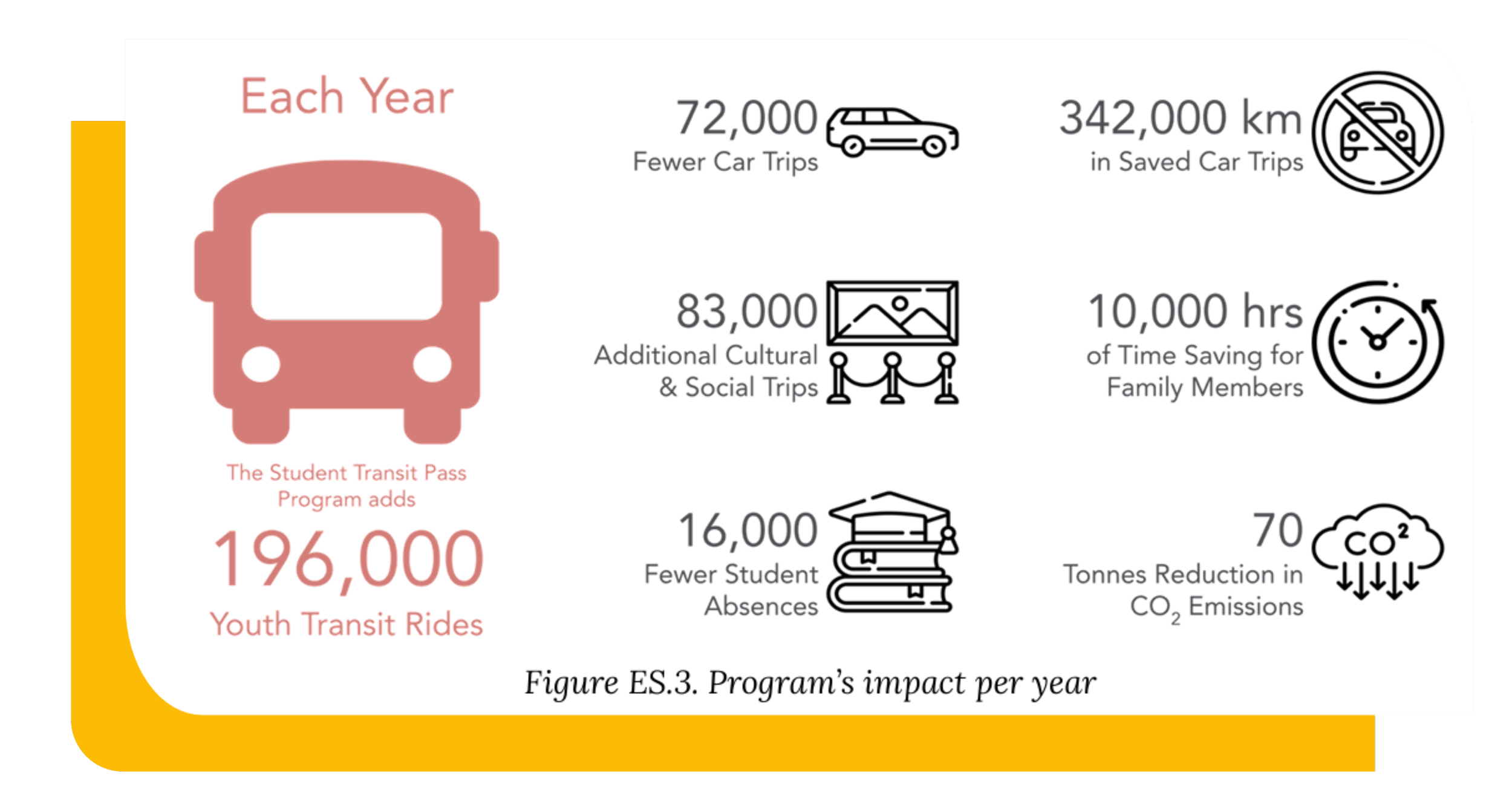
Analyzing data from 2012 to 2019, the report shows that Kingston’s program generated nearly 196,000 additional youth transit rides annually – displacing an estimated 72,000 car trips and saving 10,000 hours of caregiver time each year. These shifts resulted in a reduction of 70 tonnes of CO₂ emissions annually and contributed to 16,000 fewer student absences, a significant improvement in educational access and consistency.
Economically, these mobility and environmental gains translated into approximately $2 million in annual societal benefits. The study reported a benefit-cost ratio of 3.6 to 1: for every dollar invested in the program, more than three dollars in value were returned to the community. The report concludes that this represents a strong and quantifiable return on investment that spans education, transportation, health, and climate outcomes.
Crucially, the report also highlights that training is a central driver of these results. Kingston’s model pairs universal high school student access with structured Grade 9 transit training, teaching thousands of students each year how to navigate the system safely and confidently. The analysis identifies training as a pivotal factor in long-term ridership uptake, establishing that equipping youth with the skills to use transit is as essential as making it free. These findings reaffirm Kingston’s leadership in building a youth-centred transit culture and offer a proven blueprint for communities across Canada exploring fare-free or low-barrier transit for young people.
Reports & Studies

Getting Edmonton Youth on the Bus: A Feasibility Study
By Sophia Young, 2024 (Small Change Fund & Alberta Ecotrust)
This Edmonton-based feasibility report explores free youth transit passes and training. Surveys revealed strong community support for fare-free programs but highlighted cost barriers. The report identifies existing subsidies, champions for policy change and opportunities for city-school partnerships. Recommendations focus on expanding access while aligning with equity and climate goals.

By Tia Howlett-Lean, March 2025 (Cape Breton University)
This MBA research project explores how public transit supports youth leadership development. Drawing on leadership theory and mobility studies, Howlett-Lean shows transit enhances independence, civic engagement and equity. The study calls for fare-free youth programs and transit training, highlighting Kingston, Ontario as a best practice example.
Next Stop, Leadership: Empowering Youth through Public Transportation

Single Mothers’ Alliance, 2023
This research brief shares parental insights on the impact of free public transit for teens, based on focus groups from Vancouver’s Reduced Fare Transit Pilot. Parents described transformative benefits: teens accessed more activities, supports and friendships; gained confidence and independence; and felt a greater sense of belonging. The findings underline the role of transit in mental wellness, inclusion and economic relief for low-income families. The report calls for extending fare-free transit through Grade 12 to ensure equitable youth mobility and opportunity.
Transit for Teens: Parental Perspectives on the Impact of Free

Free Transit for Youth on the Sunshine Coast: Feasibility Study
By Anna Lattanzi, November 2023 (Sunshine Coast Regional District)
This feasibility study assesses the impact of providing fare-free transit to youth aged 13-18. Findings show strong community support, with clear benefits for equity, GHG reduction and youth independence. A school-administered “combined pass” is recommended, supported by partnerships between the school district and local government.

Reduced Fare
Transit Pilot Update
City of Vancouver Council Memo, September 2022
This memo summarizes Vancouver’s pilot providing reduced fare transit to low-income residents. Findings show improved access to health, employment and social connection. Though limited in duration and scope, the pilot supports broader affordability measures like the #AllOnBoard campaign for free youth transit and sliding-scale fares.
By Reed, Marchbank, and Travers, December 2021 (SSHRC)
This national synthesis compiles 10+ years of research on youth and transit, including youth-led advocacy, fare policies and involvement with transit authorities. The authors call for policy changes, inclusive engagement and expanded fare-free programs to support youth mobility, equity and long-term transit ridership.
Youth and Public Transit: A Knowledge Synthesis

By Jacqui Scaman, June 2019 (City of Charlottetown & T3 Transit)
This report evaluates a pilot offering free bus passes to high school students in Charlottetown. Participants used transit more often, gained independence and engaged in more activities. Despite positive outcomes, most students indicated they wouldn’t pay for future passes due to cost barriers. The report recommends expanding the free pass program with shared funding.
The Impact of Subsidized Transit Programs
in Charlottetown
High Schools

By Veronica Lee Sullivan, August 2017 (University of Waterloo)
This thesis evaluates Kingston, Ontario’s complimentary transit pass program for high school students, examining its influence on youth mobility, ridership, and household transportation needs. Using survey data and ridership analysis, Sullivan found that as students gained experience with transit, they rode more frequently, unlocking greater independence and access to activities. Parents also reported fewer spatial constraints on their children’s mobility. The study concludes that fare-free programs can be a powerful tool to support youth travel autonomy and recommends similar initiatives in other mid-sized North American cities.
Impact of Free Transit Passes on Youth Travel Behaviour
Council Reports
Our goal is to create the most up-to-date library of resources from communities who are acting on free youth transit. See a resource that's missing? Let us know at info@getonthebus.ca!
-
The City of Barrie and the Simcoe County District School Board are piloting free transit passes for 82 Innisidale Secondary School students. They are reviewing the program’s impact during the 2024–2025 school year and will consider an expansion based on results.
City of Barrie:
-
In spring 2023, Belleville announced a free transit initiative for high school students. The program includes an orientation for Grade 8 students and aligns with the city’s Transportation Master Plan to create a viable and accessible transit system.
City of Belleville:
-
In August 2023, Burlington City Council introduced free transit for youth on evenings and weekends. This program was introduced following the success of a similar seniors’ pilot that saw a 41% ridership increase and became permanent in 2022.
City of Burlington:
-
Brantford Transit and the Grand Erie District School Board now provide free transit passes to Grade 9 Brantford Collegiate Institute students in West Brant who don’t qualify for school busing—improving access, easing commutes, and supporting student independence.
-
Charlottetown’s 2019 pilot offering free transit passes to high school students increased independence and after-school participation while reducing reliance on family rides. The program expanded citywide the following year and helped pave the way for PEI’s 2022 province-wide free transit policy for all youth under 18.
-
Dieppe’s free transit-pass program gives youth aged 6-18 free access to the Codiac Transpo network (under-12s region-wide; 12-18 within Dieppe), helping reduce financial barriers and promote sustainable travel.
-
Guelph launched a Youth Ride Free pilot in February 2025, offering free evening and summer transit for ages 13–17. Early results show strong uptake and the pilot will continue through December 2025.
-
Halifax Transit’s pilot program was expanded — thanks in part to provincial funding — for the 2024-2025 school year. The program now includes over 28,000 students in grades 7 to 12 across 59 schools.
Halifax Regional Council:
December 17, 2020 - Report: 2021/22 Student Transit Pass Pilot Program
April 12, 2021 - Report: Expanded 2021-2022 Student Transit Pass Pilot Program
November 8, 2022 - Report: Student Transit Pass Pilot Program - Phases 2 & 3
November 23, 2023 - Student Transit Pass Program Transportation Standing Committee
November 23, 2023 - Transportation Standing Committee [YouTube]
August 29, 2024 - Student Transit Pilot Pass program Expands News release
May 12, 2025 - Student Transit Pass Pilot Program Update Memo
-
The Kingston High School Bus Pass Program, launched as a pilot in 2012, now offers free bus passes to all students in Grades 9–12 and includes annual on-bus orientation. This pioneering initiative, the first of its kind in Canada, has become a model of innovation and sustainability. Children 14 and under also ride free without passes.
City of Kingston:
June 19, 2012 - Grade 9 – Community Activity Pass – Addition of Kingston Transit Access
July 16, 2013 - Kingston Transit – Grade 9 Transit Pass Pilot Program
June 17, 2014 - Kingston Transit – Grade 9 & 10 Transit Pass Extended Pilot Program
June 16, 2015 - Kingston Transit – Secondary School Complimentary Transit Pilot Program
May 3, 2016 - Kingston Transit – Secondary School Complimentary Transit Pilot Program
August 9, 2022 - Report: Kingston Transit - High School Transit Pass Program
-
The District of Kitimat is announcing the implementation of free fares for k-12 students in the Kitimat Transit System as part of a one-year pilot project.
-
London is exploring expanding it’s secondary school free fare pilot from only grade 9’s to all secondary school students. Limited to the school year to save on summer costs. A 2 year pilot is being proposed.
-
The city of Mississauga is currently running a youth-free transit initiative for the summer months. Running since 2023, the program has expanded to cover youth ages 12 - 16.
-
Nanaimo is currently piloting a 2-year fare-free transit initiative for all youth under 18, with the start date expected to be September 2026.
-
In May of 2023, Oakville Transit introduced fare-free service for seniors and youth aged 13 to 19. In the program’s first month, youth ridership rose by 85%.
Town of Oakville:
-
Orangeville launched a fare-free transit pilot for all riders in January 2023. The program resulted in a steady increase in ridership—from 8,259 in June 2022 to 20,131 in June 2023. The program has been extended until 2027.
Town of Orangeville:
-
Launched as a 12-month pilot in 2024, Orillia’s free transit program for teens aged 13–19 was made permanent in 2025. The program provides no-cost rides on Orillia Transit with a reloadable cOnnect transit card, helping youth build independence and access school, work, and community activities.
City of Orillia:
-
Prince Edward Island introduced fare-free transit for all youth under 18 in its 2022–23 provincial budget, alongside major fare reductions for other riders. The policy, aimed at improving affordability and encouraging sustainable transportation, has been renewed each year since and remains in place in the 2025–26 budget.
May 20, 2022 - Investing In Our Youth Budget Background 2022
May 3, 2024 - Province invests to freeze public transit fares again
2025 - Securing Our Communities And Infrastructure Budget Background 2025
-
The City of Peterborough is introducing a free transit program for youth and high school students, with a phased rollout beginning in spring 2026 for ages 13–14 and full implementation expected by summer/fall 2026. The initiative aims to make transit more accessible for young riders and encourage lifelong transit use.
City of Peterborough
-
Regina launched a four-month fare-free transit pilot at Johnson Collegiate on September 2, 2025, providing free bus rides for all students along Route 9.
-
Sudbury is exploring what fare-free transit for youth could look like. Currently in the discovery phase.
-
The Sunshine Coast launched its S-Pass program in November 2024, offering free transit for youth aged 13–18. The launch came after a 2023 youth delegation spurred the Regional District to study and approve funding, with early reports showing strong increases in ridership and a shift in transit culture.
Sunshine Coast Regional District:
December 3, 2019 - Infrastructure Services Committee - Minutes
December 3, 2019 - Infrastructure Services Committee - Video
January 26, 2023 - Infrastructure Services Committee - Minutes
January 26, 2023 - Infrastructure Services Committee - Video
November 8, 2023 - Free Transit for Youth on the Sunshine Coast Feasibility Study
February 5, 2024 - Infrastructure Services Committee - Video
May 29, 2025 - Intergovernmental Roundtable on Sunshine Coast Transit Service Priorities
-
Launched as a pilot during the 2024-2025 school year and renewed for 2025-2026, this program provides free TTC transit for Grade 7–12 student field trips. The program, developed with Toronto’s school boards, helps students become more comfortable using transit while expanding access to educational opportunities across the city.
Toronto Transit Commission:
-
Vancouver ran a Reduced Fare Transit Pilot in 2021–2022, providing free six-month passes to 100 low-income participants, including teens. Results showed improvements in accessibility, independence, and well-being.
-
The city of Whitehorse is currently in the discovery phase and exploring how it could implement fare-free transit for youth.
-
Supporting its municipalities, Yukon is looking at ways to help fund transit across the territory.
“The free bus pass allowed me to develop independence since I was no longer reliant on my parents for rides, and improved my social life dramatically since I could travel across town reliably without charge.”
— Saige Clark, Frontenac Secondary School Alumna