
When We Say Youth Transit—What Do We Mean?
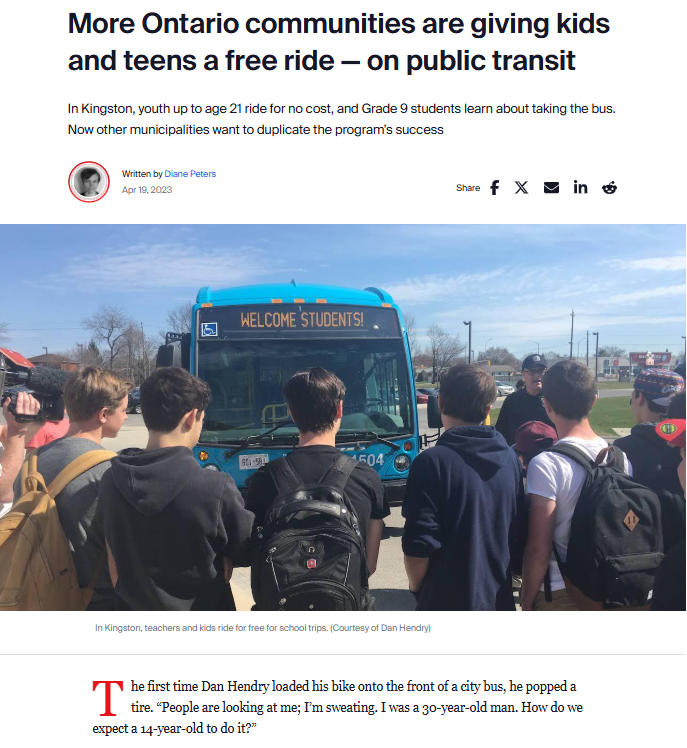
Image Supplied by: TVO Today website
Across Canada, more communities are asking an important question: When we talk about youth transit, what are we really talking about? At its core, youth transit is not just about free fares or discounted passes. It is about intentional investment in young people so they can experience, understand, and grow with public transit as part of everyday life.
The evidence in favour continues to build. Communities that invest in youth mobility are seeing wide-ranging societal benefits, from improved access to education and employment, to stronger mental health outcomes, to long-term ridership growth. Kingston, Ontario, has demonstrated this clearly over more than a decade. Their High School Transit Pass Program showed that when barriers are removed and training is embedded, youth adopt transit quickly and confidently. But Kingston also reminds us of something important: these successes take time, coordination, and patience for systems to adapt.
What is especially encouraging today is the diversity of approaches emerging across the country. There is no single “right” way to start.
In North Bay, the conversation is advancing through the Community Safety and Well-Being lens, recognizing that youth mobility directly connects to broader social outcomes. Burlington provides another thoughtful model: they started with evenings and weekends during non-peak periods, then expanded to summer service, and now offer a structured monthly ride allocation. This incremental approach builds operational confidence while steadily investing in youth access.
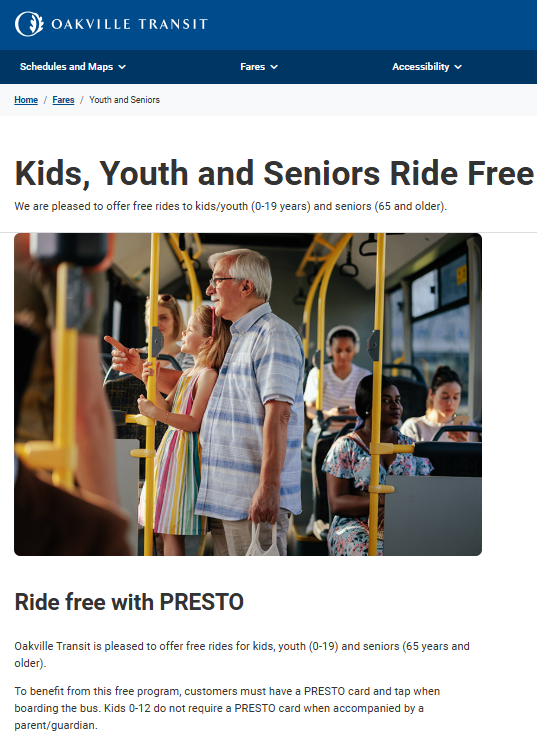
Image Supplied by: Oakville Transit website
Other communities have chosen to move faster. Oakville went all-in with free transit for youth aged 13–19, demonstrating strong municipal leadership and commitment. Halifax took a more gradual path over five years, ultimately scaling to serve roughly 30,000 youth with continued provincial support. Their parent and youth survey, with over 8,000 responses, has provided valuable insight into how families use and value the program.
Large systems are finding their own entry points as well. The Toronto Transit Commission, recognizing its scale and complexity, has focused on structured field trip programming on designated days. While different in scope, it still reinforces the same principle: give young people meaningful opportunities to experience transit early.
This is where the conversation must stay grounded. Municipalities are on the front lines of many pressures, and funding realities are very real. Yet the long-term return on youth transit investment continues to show up across multiple policy files, productivity, workforce participation, climate goals, accessibility, equity, and sustained ridership growth.
Importantly, fare policy alone is not enough. The strongest programs across Canada pair access with training, engagement, and culture-building. Youth need to know how to use the system, why it matters, and where it can take them.
So, when we say youth transit, we are really talking about a long-game investment in community vitality.
Start where it makes sense. Pilot. Phase. Scale. Learn.
Across Canada, communities big and small are proving that there are many pathways forward. But the direction is increasingly clear: investing in youth mobility today creates powerful economic, social, and cultural benefits tomorrow.
And the best time to start is now.